
The Union Flag is one of timeless design. A three to five height to width ratio, with Red, White, and Blue colours showing off the grandeur of Britain to the world. It is classic and necessary for any British vexillologist’s collection. The design was finalized in 1801, when acts of Union with Ireland were finalized. This banner is a perfect synthesis of the three Cross and Saltires of the National symbology of England, Scotland, and Ireland, using the three patron Saints of the respective nations.
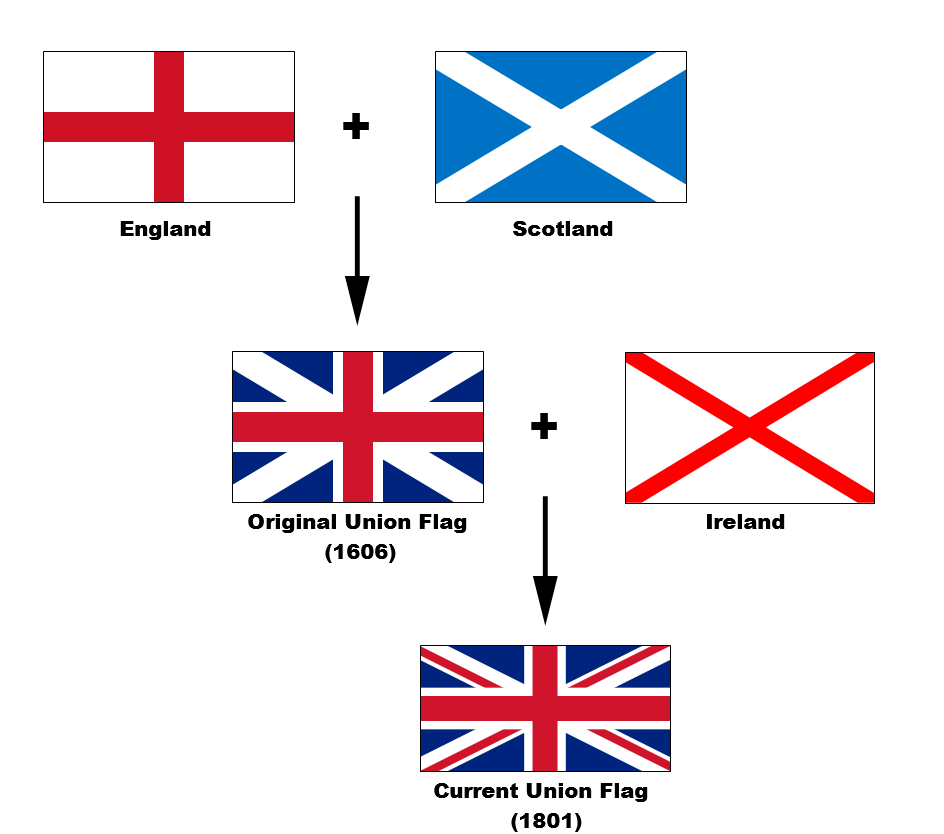
St. George’s Cross, which consists of a Red horizontal Cross on a white field, is likely the oldest of the three, first becoming associated with England in the 10th century. Next came the Cross of St. Andrew, or St. Andrew’s Saltire. The Scottish association came later, in the 13th and 14th centuries. It was combined with England’s Cross in 1606, but became the national flag of Great Britain in 1707, 101 years later. It was 76 years later when the association of the Saltire of Saint Patrick became formally associated with Ireland, in 1783. It then joined the Union Flag just eighteen years later, with the makings of the current design.

The variations of this flag are as numerous as the nations of Earth. The Union Flag in its alternative height to width ratio of one to two becomes the Union Jack, a Naval flag for the ages. This flag in turn takes a great many defacements of its various ensigns to create the many colonial flags of the British Empire. Coloured in red and blue, although with sky-blue, green, and white variations, the commonly known Blue Ensign and Red Ensign or Red Duster as it is more colloquially known sport the badges of overseas territories, crown colonies, dependencies, and protectorates, to create the banners of Empire.

The other common British symbols which do often appear in the banners of the Empire and even today, is the Cross of St. George, and Royal emblems such as the Royal Banner of England and Scotland, or that of the general Royal Standard. These banners comprise of Lions rampant or passant guardant heir from medieval days when the Lion was as rare to the kings of Europe as was the Unicorn of the forest. The lower left quadrant of the Royal Standard notably features the Irish Harp, the mythological representation of Erin, a female personification of Ireland, much like Britannia to Britain.

Though these flags have stood the test of time, they have mostly faded in the contemporary understanding of the national symbology of the World. Though do not forget, it was once these Ensigns, Banners, Standards, Flags, and Jacks which flew across the globe and gave so many Britons in countless lands a sense of being British, a pride that does not wane. Whichever flag you will choose to invest in at Britannia Flags, we ensure that each design remains steeped in stories, and will be expertly crafted and made with care, so that the threads of the British legacy will continue to wave aloft wherever the hearts of eager Britons will it.